The Great March of Democracy by S Y Quraishi
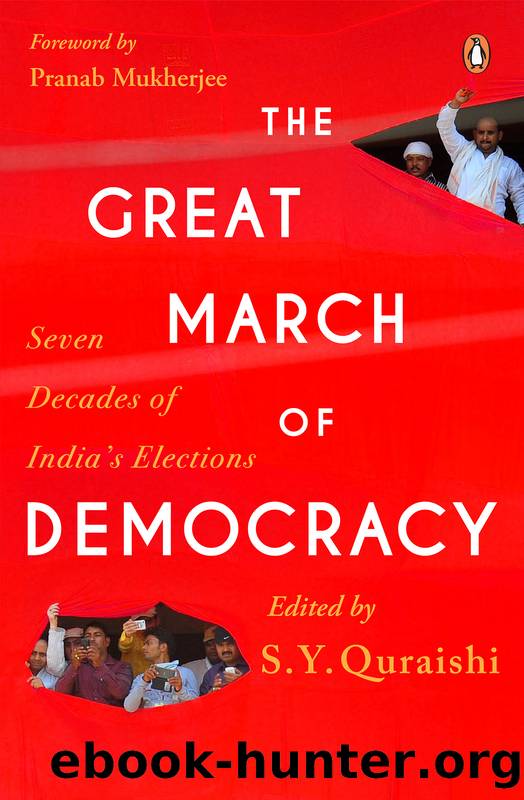
Author:S Y Quraishi [Quraishi, S.Y.]
Language: eng
Format: epub
ISBN: 9789353054564
Publisher: Penguin Random House India Private Limited
Published: 2019-01-02T00:00:00+00:00
Womenâs Participation
Demographically, Nepal has more women (51 per cent) than men (49 per cent). But in the general elections of 2017, the percentage of women voters (49 per cent) was less than that of men (51 per cent). This is a sign that women are still not as politically aware. However, in terms of representation, women have a very respectable seat on the table due to constitutional and legal provisions, beside the countryâs commitment to the Convention on the Elimination of All Forms of Discrimination Against Women (CEDAW). Combined with treaty obligations, the rising expectations and aspirations of the people led to Nepal formulating a progressive and forward-looking constitution in 2015.
This constitution ensures that there is at least one woman member and one Dalit woman member in each ward, which means the presence of at least 40 per cent women in the local governments. Further, the Election Commission proposed that political parties must ensure that they field at least 50 per cent women candidates between chairperson and deputy chairpersons of local levels, which include rural municipalities, municipalities, sub-metropolis and metropolis. As a result of these elections held under the new constitution, the country has 41 per cent women in powerful local governments, 34 per cent in provincial assemblies, 33 per cent in the House of Representatives, and 33 per cent in the National Assembly. 7 In 96 per cent of local-level units, the elected head is a man, however, in 95 per cent of local-level units, the deputy is now a woman. The constitution provides that between the president and the vice-president of the country, one must be a woman. 8 Consequently, Nepal also has a woman president, Bidhya Devi Bhandari, who was recently re-elected in March 2018. 9
The Election Commission has always believed in proportional participation of women in the entire electoral process. The Commission believes that women should be represented proportionately, not only as voters and candidates but also in election management and security. It is not always possible to do so in choosing its officers as the percentage of women in the civil service pool is very low. The ECN tries to make up for this by securing reservations for women wherever possible. This is why the ECN deploys at least 50 per cent women among volunteers in polling stations and asks the home ministry to hire 50 per cent women as temporary security personnel. The Election Commission has also reduced the candidacy nomination fee by half for women candidates. Separate queues for women voters are arranged and instructions given to polling staff and security to be sensitive to needs of people with disability, pregnant women and new mothers. In every election, some polling centres are managed by women as a confidence-building exercise for women voters.
The ECN has tried to ensure a gender equality and social inclusion (GESI) perspective in all legal framework, including in its internal operation. As mentioned earlier, the Commission prepares the initial drafts of laws and has always promoted greater participation of women in laws related to political parties and other electoral ones.
Download
This site does not store any files on its server. We only index and link to content provided by other sites. Please contact the content providers to delete copyright contents if any and email us, we'll remove relevant links or contents immediately.
| Anthropology | Archaeology |
| Philosophy | Politics & Government |
| Social Sciences | Sociology |
| Women's Studies |
Cecilia; Or, Memoirs of an Heiress — Volume 1 by Fanny Burney(32558)
The Great Music City by Andrea Baker(32019)
Cecilia; Or, Memoirs of an Heiress — Volume 2 by Fanny Burney(31956)
Cecilia; Or, Memoirs of an Heiress — Volume 3 by Fanny Burney(31942)
We're Going to Need More Wine by Gabrielle Union(19046)
All the Missing Girls by Megan Miranda(16030)
Pimp by Iceberg Slim(14508)
For the Love of Europe by Rick Steves(14121)
Bombshells: Glamour Girls of a Lifetime by Sullivan Steve(14077)
Talking to Strangers by Malcolm Gladwell(13370)
Norse Mythology by Gaiman Neil(13367)
Fifty Shades Freed by E L James(13243)
Mindhunter: Inside the FBI's Elite Serial Crime Unit by John E. Douglas & Mark Olshaker(9344)
Crazy Rich Asians by Kevin Kwan(9292)
The Lost Art of Listening by Michael P. Nichols(7506)
Enlightenment Now: The Case for Reason, Science, Humanism, and Progress by Steven Pinker(7314)
The Four Agreements by Don Miguel Ruiz(6765)
Bad Blood by John Carreyrou(6622)
Weapons of Math Destruction by Cathy O'Neil(6281)
